
On September 1, International Special Representative Dan Mahoney joined Mayor Mamdani and Deputy Mayor Julie Su at New York City Hall for a roundtable discussion focused on the workers impacted by the September 11, 2001, attacks.
The meeting brought together a small group of ten individuals from the labor movement and the local community, including a teacher from Stuyvesant High School and a small business owner from Lower Manhattan. Dan was invited to discuss Local 52’s response at the World Trade Center (WTC) and the marshaling area at Shea Stadium on September 11, 2001. He also took the opportunity to broaden the conversation, highlighting the efforts of IATSE local unions across the country that stepped up “behind the curtain” to support New York City and the nation during one of its greatest hours of need.
Twenty-five years later, as we reflect on September 11, 2001, it is important to remember not only the impact the attacks had on workers and communities, but also the solidarity and service that emerged in the days that followed. Dan offered important reflections on the experiences of workers in the aftermath of 9/11 and IATSE’s response to the attacks, including the union’s efforts to support and assist those affected. His perspective provides a firsthand look at how IATSE members, leaders and industry kin answered the call during one of the nation’s darkest moments. Here’s a closer look at Dan’s responses and reflections from the roundtable discussion.
What I Wish More New Yorkers Knew About How IATSE Showed Up After 9/11
The International Alliance of Theatrical Stage Employees, or IATSE, represents the “behind-the-scenes” technicians, craftspeople, and artisans who make the entertainment industry possible. In New York City, our members work on motion pictures, television, commercials, Broadway, and live entertainment.
What I wish more New Yorkers knew is that, immediately after the attacks on September 11, IATSE members went down to the World Trade Center to ask one simple question:
What can we do to help?
It was a horrific scene. The FDNY, NYPD, and Port Authority Police were beginning the rescue effort, but night was approaching, and Lower Manhattan had lost its power. Without emergency lighting, the rescue operation would be severely hampered.
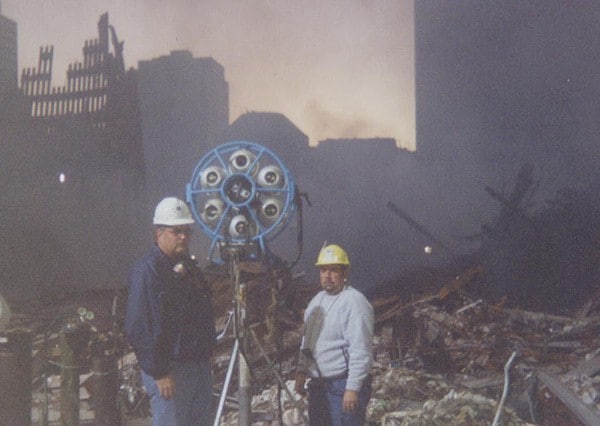
On that first day, Local 52 electrician, or “gaffer,” Lowell Schulman was at the World Trade Center and made contact with Captain Robert Wilson of the Mayor’s Office of Emergency Management. Captain Wilson explained that the city urgently needed emergency lighting at Ground Zero.
Local 52 member Jimmy Miller, owner of Angel Aerial Trucking, supplied trucks loaded with equipment, sweatshirts, hats and gloves to the rescue workers immediately after the attacks. Angel Aerial also supplied the “Water Trucks” that kept the toxic dust at the WTC in check in the coming days, weeks and months until the recovery operation was completed in June of 2002. A crew of Local 52 and Teamsters from Local 817 worked throughout that time.
Ruby 7 lights designed by Local 52 and Local 600 member Charlie Liben and Local 52 member David Scutch were vital to the rescue operations too. A “Ruby 7” is now part of the permanent exhibition at the WTC museum detailing the movie “lights” at the WTC 2001.
So, we did what we knew how to do.
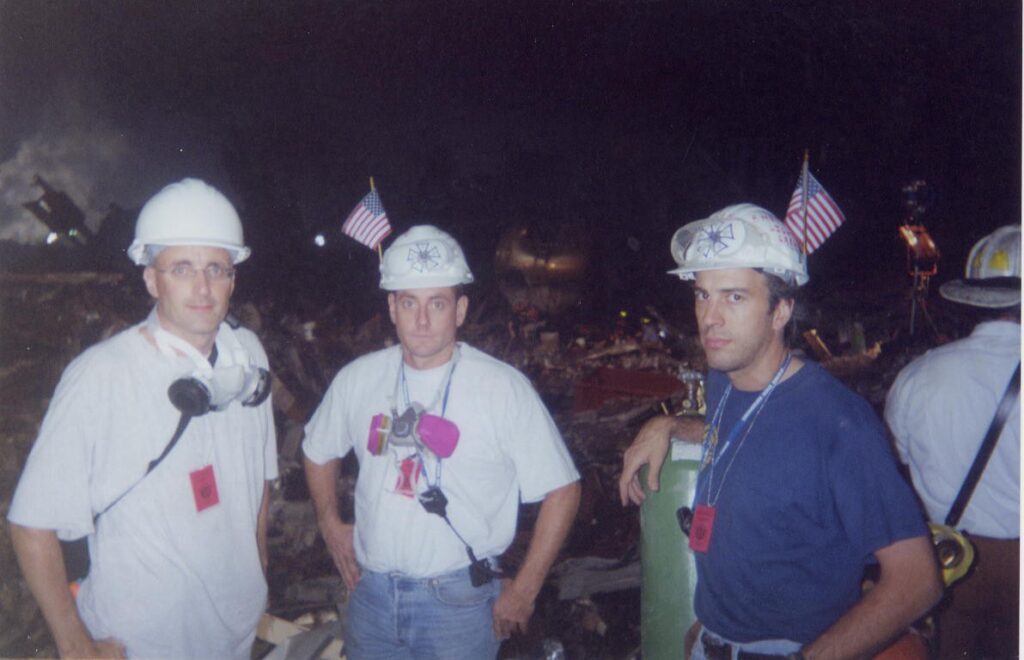
Local 817 Theatrical Teamsters brought in the specialized motion picture lighting equipment and generators. Local 52 and Cinematographers Guild, Local 600 crews that normally illuminated television and film productions throughout New York City, such as Law & Order, were now using those lights for the rescue effort at the World Trade Center.
For days and weeks, those crews worked around the clock, placing powerful lights throughout the site and specialized lighting beneath the debris field, working alongside the search-and-rescue teams. Our grips, electricians, and special-effects technicians also used the heavy mechanical tools and rigging expertise they normally used in filmmaking to help cut through and move thousands of tons of tangled steel and reinforced concrete.
And our industry stepped up without hesitation. Companies including Silvercup Studios, Broadway Studios, Kaufman Astoria Studios, Feature Systems Lighting and Grip, Paramount Studios production Lighting, Panavision, Musco Lighting, Camera Service Center Lighting and Grip, and many others immediately supplied trucks, generators, lighting, and equipment.
Tony Argento of Broadway Studios had a truck of lighting equipment at the site that first night. More equipment, as detailed above, followed until the entire site was illuminated.
Because of that effort, the rescue and recovery operation never stopped for lack of light. It continued 24 hours a day, seven days a week.
Local 52 and Teamsters Local 817 crews also provided around-the-clock lighting at the first responder marshaling area at Shea Stadium. On September 21, 2001, our crew provided the specialized lighting of a giant American Flag that was draped on the side of Shea Stadium for the first baseball game after 9/11.
Broadway stagehands from Local One and members of United Scenic Artists, Local 829, and other IATSE local unions helped build and rig the lighting and staging for the Interfaith Memorial Service at Yankee Stadium on September 23, 2001.
The lights on Broadway and those performances were back on September 13, 2001, just two days after the attacks. The IATSE Broadway local unions and the entire Broadway community displayed their solidarity and support for our city by returning to work so soon after the attacks. Those Broadway shows being back and up and running showed the world that we New Yorkers and our city were facing that unimaginable tragedy with an unshakable resolve that we New Yorkers might be battered, but we are far from broken!
Through our city’s and our country’s darkest hour, the entertainment industry’s “behind-the-scenes” people stepped forward and brought light into the darkness from those horrific days.
In Remembrance and Solidarity,
Dan Mahoney
To learn more about IATSE’s response on September 11, 2001, read Local 52’s article, “From Behind the Lens to the Front Lines: The Heroic Response of Studio Mechanics at Ground Zero,” featured here.